The Words I Could Never Understand Then, That Could Only Be Understood Now

ImageI binged on 90s music last week and rediscovered some of my favorite gems. Among them, Sinead O’Connor’s “Nothing Compares 2 U,” Primitive Radio God’s “Standing Outside a Broken Phonebooth,” and The Indigo Girls’ “Closer to Fine.” I sung them freely around the house, delighting in the early evening spring sun shining through opened blinds, grateful to be in the present moment, yet overcome with nostalgia and wisdom from time’s past.
I think that’s one of the gifts music provides. That no matter your musical history, the words and melodies will find a way to speak to your heart. My small brush with musical talent began in first grade when I got to play the glockenspiels for three years in a row in the winter concert. The best part of all— my music teacher would let me come practice in the music room during lunch time. I figured out what mallet to hit based on sound and never learned how to read music. FACE, Every Good Boy Does Fine— that was a foriegn language I could never understand. In fact, I only made it through high school chorus by knowing that when the music notes flipped upsidedown, that was my part to sing, being a soprano. Needless to say, it’s a talent I never possessed but appreciate like no other.

Music’s gotten me through training practices, heartache, amplified my best days, and softened my worst days. It’s provided me clues of my past and offered wisdom for the future. So as I was singing the familiar harmonies of “Closer to Fine,” I was struck by all the things I missed while singing those words back in the 90s. Things I could never understand until my heart developed into a melded mess from beating fast, and being held after brokenness. Things I could never understand until my memories included those of pain, uncertainty, doubt, big decisions, hard breaks, tough calls, and the freedom of the open road and hostels. Experiences, in other words, that my young heart was too naive to understand until it went through the hard process of growing up and maturing.

I think much like music, pictures or stories speak to us in different ways throughout our life span. As a kid, The Giving Tree was an awesome book about a boy and a tree that fell in love with each other, and now -call me jaded, but- it feels like a story of a selfish little boy who manipulated a codependent tree. I’m still a sucker for Oh The Places You’ll Go, though, and will forever wonder what a zizzer-zazzer-zuzz is in Dr. Seuss’ ABC.

Similarly, much like pictures and stories, parents and friends speak to us in different ways throughout our life span. I learned the joy of what it feels like once you finally see your parents outside of an authoritative role and into the role of an old friend, finally understanding the sacrifices they made to bring your little life into existence. I learned the great sadness it feels to see a parent sick in the hospital, as you question their mortality, and yours as well.

And much like parents and friends, faith/God/a Maker/Creator, can speak to us in different ways throughout our lifespan. That’s one of the things The Indigo Girls reminded me of last week. While I relate to the Indigo Girl’s description of what it feels like to take life less seriously and to search for the things that will fill our heart with peace, perhaps what sticks out most to me is the refrain, “The less I seek my source for some definitive, the closer I am to fine.” And how true is that of life, or faith, or getting older and “growing up?” Why does it feel like my human nature to tighten my fists, muscling through things the way think they should go, when perhaps it really would be easier to turn my gripped fists into open palms? Why do I look at paper applications and beg for certainty that everything in my life will all turn out ok, and then lay on my front porch, stare up at the stars, and suddenly don’t care anymore? Don’t care about career. Don’t care about when to get married, if/when to have kids. Don’t care about my sh*tty salary. Don’t care how I’m perceived. Don’t care if I’m understood. And, most freeing of all, don’t care about certainty anymore. And the less I beg of God for answers to life’s questions, the less I feel like I need to explain or defend why I don’t really go to Church anymore because of the way I experience Church when I ride my bike, when my sister smiles, when I feed the chickens, and when I sing old 90s songs alone in my room that feel less like pop culture and more like hymns. 

I’ll stop asking for certainty.
And trust that the God that got us this far can get us the rest of the way.
I’ll linger under stars.
Stand up on my bike pedals when going downhill.
Do headstands in the grass.
Get fresh Earthen dirt under my nails.
Learn from the birds, the bees, and the beats of 90s rock. 

Because I’m closer to fine than ever before
And we’re all gonna be ok. 


The ABCs of Gender, Sexual, and Racial Equality

Photo credit: Leanna B. Powell

One of Baltimore’s cafes that promotes equality right on down to bathrooms. Love Red Emma’s! Photo credit: Leanna Powell

I’ve been having some of the most mind-opening conversations of my life recently as I’ve been interviewing women and men about gender and listening to podcasts covering privilege, gender, and sexuality. In discussing and listening, I’ve come across terms that I was unfamiliar with (such as “cis-gendered”). This piqued my curiosity to learn more about gender, sexual, and racial equality. Below are some terms that may be helpful in educating ourselves and others about gender, sexual, and racial equality. This list is by no means comprehensive, but just a smattering to get your feet wet. Whether you’re well-versed in your equality vocabulary, or just beginning advocacy efforts, you are needed. No matter where you are in the journey, let’s ask each other questions, have a posture of a learner, ask how we can help one another as allies, and change the world. Comment below with your experiences in allyship, advocacy, or questions about these words/topics.

Asexual: one who does not experience sexual attraction
Ally: (in context of equality) one who unites with other causes, organizations, or people to promote the global concept of equality promotion (ex: a gender ally, an LGBTQIA ally)

Binary supremacy: the belief that genders fall into two (and only two) separate and distinct categories and that a male or female identity is superior to other identities
Butch: A woman who adopts what would typically be considered masculine characteristics. Note: This is not a derogatory word when used for self-identification. Just like “gay,” or “retarded,” the word is not inherently disrespectful; it’s only disrespectful when used inappropriately.

Cis-: as in, cis-gendered: identifying with your biological sex.
Cis-privilege: The benefits and privileges that go along with identifying with one’s biological sex.

Dyke: Lesbian. Note: this is not a derogatory word if someone self-identifies as a “dyke.” Some women do not like the word “dyke” because of its oppressive roots, while others have reclaimed the word and found identity as a “dyke.”

Egalitarian: Having equal rights, regardless of social, economic, or other distinctions such as income, race, or religious or political beliefs; as in egalitarian marriage (vs. complimentarian marriage),  for example.
Equity (vs equality)In simple terms, equity is equipping everyone what they need to be

equity

Photo credit: Everyday Feminism

successful. Equality is treating everyone the same. Consider the image below- if everyone was equal, they’d have the same view, right? But what about the children? They need a boost to be able to enjoy the same view. Policies like affirmative action are temporarily necessary to give equity to educational and career opportunities until people of less privileged backgrounds who’ve had long histories of exclusion can experience equality.

Femmephobia: The devaluation, fear, and hatred of the feminine and anything commonly related to femininity (the color pink, high heels, etc.) that denotes femininity as inherently inferior.

Gay masculine of center: One example of many forms of self-identification, this identity is used by some women who tilt toward a masculine side of gender identity
Gender binary:
Classification of sex and gender as two separate and distinct identities: feminine and masculine

Hapa: A term that originated in Hawaii to describe one who identifies with mixed racial heritage, with partial roots in Asian/Pacific Islander ancestry.
Heteronormativity: The social and cultural constructs that assume heterosexuality is the norm.
Homosexuality: A word some find hurtful, as it links to days when homosexuality was a clinical disorder (some instead advocate using “a person who is gay/lesbian”); a term that The New York Times dropped from usage in 1987, while Fox News continues to lag behind.

Intersectionality: The concept that cultural oppressions (i.e. gender, race, class, and sexual orientation) are all intertwined and that we can be oppressed through multiple identities (ex: a gay African American can be discriminated against for being BOTH gay AND African American)
Intersex:
A condition experienced by approximately 4% of the population in which there are genetic, hormonal or physical differences thought to be typically male AND female. Some choose to self-identify as intersex, while others find this identity troubling. One thing we can agree on: Don’t use the word ‘hermaphrodite!’

Jail: The place 97% of rapists don’t enter; the place where a gay Ugandan can go by law simply for being gay through the 2014 Uganda Anti-Homosexuality Act (rooted in laws from British colonization); the place where interracial couple Mildred and Richard Loving were sentenced to for interracial marriage in 1958.

Kinsey scale: A rating scale developed in 1948 in order to account for research findings that showed many people did not fit into neat and exclusive heterosexual or homosexual categories.

Late onset adrenal hyperplasia: One example of an intersex presentation affecting 1 in 66 individuals.
LGBTQIA: Acronym for Lesbian, Gay, Bisexual, Transgender, Queer, Intersex, Asexual/Ally

Microaggressions: small, everyday examples of negative statements about a non-dominant group or marginalized identities; may be implicit or explicit.  
Monosexism: Belief that a person can only be attracted to ONE (and only one) gender.

Non-binary: Umbrella term for anything that doesn’t fit in the stratified gender binary model; one can self-identify as non-binary.  

Outing: When someone reveals another gender identity or orientation often without the person’s consent or approval.

Pixie manic dream girl: A female trope known to be carefree and playful and whose primary role in a film, book, or television show is to awaken the heart of a man. What does this have to do with equality? Equality is a byproduct of acknowledging the unequal or oppressive messages we encounter in everyday life, including media and advertising.
Privilege: A special right, advantage, or immunity granted or available only to a particular person or group of people. In simpler terms, “a set of unearned benefits given to people who fit into a specific social group.’

Queer: Umbrella term for one who identifies outside of the societal norms in regards to gender and sexuality; once was considered a derogatory term but has now been reclaimed by many LGBTQIA as a desired form of self-identification.
Queer femme: One of many forms of self-identification; typically someone who identifies as a lesbian who exhibits typically feminine traits.

Racialized sexism: When women of color are discriminated against in both race and sex, often stemming from issues of privilege

Sexual entitlement: Belief that another “owes” you sexual encounters that can take the form of sexual harassment, ogling strangers, and demanding sexual favors. While any gender can act sexually entitled, women disproportionately experience male sexual entitlement as expressed in many media, language, and cultural norms or attitudes
Sexual fluidity: Term used to describe that one’s sexual identity and attractions can shift throughout the lifespan; there is a tendency for sexual minority women to experience higher levels of sexual fluidity than men.

Third wave feminism: Current wave of feminism (though some advocate we’re in the fourth) that began in the 1990s focusing on changing cultural constructs of language, embracing intersectionality and allyship (in regards to sexual orientation/identity, race, and class), securing equal opportunities for women, and celebrating the accomplishments of women past and present.

Photo credit: UN

Photo credit: UN

UN Millennium Development Goal 3: One of the 8 goals established in 2000 by the UN to “promote gender equality and empower women” internationally

Vagina Monologues: Play written by Eve Ensler depicting womens’ experiences with masturbation, rape, sex, orgasm, female genital mutilation, menstruation, love, and birth.
V-Day: Global activist campaign started by Ensler to end violence against women and girls. V stands for Victory, Valentine, and Vagina.

Women only space: A place committed to empowering women in safe spaces; historically the women’s movement failed to include trans women but is now changing to promote inclusion. Opinions vary about women-only spaces. I personally have benefited from women-only spaces and also felt torn about them- a post for another time.
Woke: (Often “Stay woke”) A phrase used to encourage critical thinking about social injustice, often used in relation to racial injustice. The term can be traced back to singer Erika Badu in 2008 but became popularized during the Black Lives Matter movement.

Xenophobia: fear and hatred of strangers or of anything that is unknown or “foreign”.

You:  A person needed to address equity and privilege while engaging others in the discussion.

Ze and zir: Gender neutral pronouns that can be used the same way “he” or “her” are used. Ze is singular, as in “he” or “she-” “Ze laughed.” Zir is a possessive pronoun, as in “it:” “I called zir.”


Resources/Education
-Developing your awareness of cissexism
-8 Ways to Stop Street Harrassment
-Identifying problematic language
-Identifying gender neutral language
-Strategies to move past “privilege guilt” 

Share your own! Comment below!


Why I Still (Occasionally) Wear Pink: The Messages Our Clothes Send

Here’s a question for you:

If pink was the designated color for baby boys, and blue the color for baby girls,
would blue be the so called “girly color”?

Like many girls, I went through a phase where I refused to wear pink, especially those obnoxious shades of “bubblegum pink,” and “hot pink.” If you’ve never been to a cosmetic store, you’ll quickly learn about all sorts of shades that you didn’t know existed, ranging from fancy dinner menu items to erotica: “raspberry sherbet,” “wineberry,” and yes, “deep throat.”

Photo: MO 2014

Photo: MO 2014

Last spring, I was met face-to-face with one of those shades of pink when I won a free pair of running sneakers. The running representative showed me the two options I could choose from: a purple pair or a pink pair. Those were the only colors this new model was being sold in by this particular company. I was disappointed to once again see the “pink or purple only” dilemma that perpetuates the intense marketing of “pink products” chosen to be synonymously associated with girlhood. That’s why I’m grateful for organizations like UK-based Pink Stinks which seeks to “run targeted campaigns aimed at creating positive changes in the products, messages, labeling, categorization and representations of girls.” Their goal is not to do away with the color, but to do away with the damaging messages girls receive from products that are often packaged in pink: pretend make up, dolls that would clearly have an eating disorder (and breast implants) if they were real, and even cleaning supplies like vacuums (who came up with the idea that this is a toy?!).
Faced with the pink or purple shoe choice, I opted for the pink sneakers, snapping out of my initial frustration to be grateful for a free pair of shoes. Privilege, I know, to be able to fuss over colors in the first place. The next thing I picked up that night after the shoes, however, was a red permanent marker. When I went home, I traced every pink outline with the red permanent marker as meticulously as I could, only it didn’t go so well. Now not only did I still have pink on my shoes, but I did such a bad job of coloring that it looked like I regressed back to middle school, when drawing on shoes was considered really cool.

After several runs in my now ridiculous-looking pair of sneakers, I realized the colors didn’t look as dreadful as I once thought they did. I also realized that in the process of eschewing pink, I was feeding into the notion that things designed for girls are inferior to those designed for men. Think back to my earlier example of what would happen if pink was the boy’s color. Let’s expand that one step further: What would happen if men were the designated care providers and women, the breadwinners? Would bread winning be looked down upon, while child rearing, praised?
Is me not wearing pink out of spite contributing to the notion that things associated with women aren’t as good as men’s? Am I continuing to let men set the tone, be it colors to stay away from, or careers to stay away from? Is it more beneficial to change pink from being a “girly” color to shun, to a color that one can wear irrespective of gender without hesitation? 

To take this even one step further, we can relate the concept of changing the connotations associated with the color pink to address the ways in which some African American and many LGBTQ communities have reclaimed words that once were considered inferior (dyke, queer, nig*^%). A friend of mine recently shared that her daughter came out as “queer.” The mother told her daughter that, “It’s ok to be gay, but must you call yourself ‘queer?'” The daughter explained to her mother why she chose to self-identify as “queer” and the two of them realized that from generation to generation, words can mean different things. Images can be mean different things. And yes, perhaps even colors like pink can mean different things.

I ponder these concepts of self-identification, reclaiming words and images, and gender as I lay out my clothes for work tomorrow, a task that’s rather innocuous, but teaching me to consider what messages or statements we can send with our clothes, bodies, and words. The decision becomes clear. I decide to wear the shirt with my preferred shade of pink (magenta) and not feel guilty about it. And hey, I may even ditch the pants today for a skirt, too.

IMG_0478

Happy World Down Syndrome Day (Thoughts on Growing Up With a Sister With Down Syndrome)

Today is March 21st— World Down Syndrome Day. For those not familiar with Down Syndrome, Down Syndrome is a congenital genetic disorder in which a baby is born with three copies of the 21st chromosome (hence why it’s celebrated on 3/21). One extra chromosome sounds rather innocuous, but results in several physical differences, such as small ears, eyes that slant upwards and poor muscle tone, to name a few of many listed by the CDC.  One thing the CDC forgot to add to their list, though, is that people with Down Syndrome seem to have some of the most joyous smiles. There are often times behavioral differences too, as many people with Down Syndrome face obsessive-compulsive, oppositional, and inattentive behaviors, to name a few listed by the National Down Syndrome Society. One thing, though, that NDSS forgot to add is that people with Down Syndrome tend to be very affectionate, resulting in some of the best hugs and “I love you’s” imaginable.

Photo: MO 2012

Photo: MO 2012

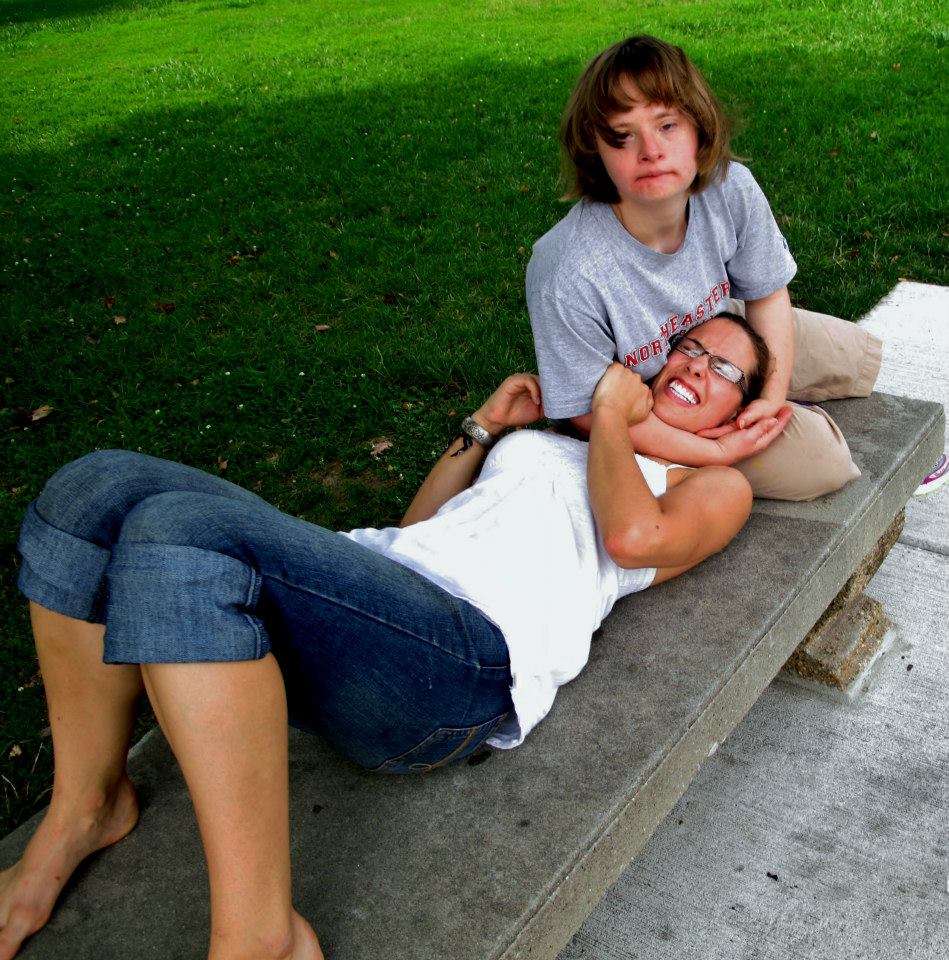
So now, I want you to meet who I’m celebrating this World Down Syndrome Day: my sister Lauren. In case you have any doubts about her age, she is quick to remind anyone that, “I’M the big sister.” Side by side, she at 4’9 and me at 5’4, it’s easy to mistake Lauren as my younger sister. But I’m the baby, and both she and my brother used to make fun of me for that. They even tried to wrestle with me growing up, and, like the picture to the left shows, Lauren still does.

Growing up with Lauren has helped me to see a spectrum of life so rich and big that leaves me in awe of the Image of God in every person. But it wasn’t always that way.
I confess, growing up, Lauren and I went from best play pals to me feeling somewhat jealous of the sisterhood my friends with older sisters experienced. I thought it would be cool to have an older sister to talk about boys with, share clothes with, and who could show me new places, especially since she would get her license before me. But we had our fun, too. We liked putting as many stuffed animals as we could onto my bed then jumping up and down as high as we could on Saturday mornings. We’d dance to loud music in the room we shared and play with chalk outside. I didn’t notice any differences then. She was my sister, and I was her sister.
Then, in elementary school, I remember being in public with Lauren and sometimes kids would stare at her. I would intently glare back at them, hoping they would see how good that doesn’t feel either. But two wrongs don’t make a right. We need to have grace with people who don’t understand, or who are not ready to understand. We need to recognize that there are people who are curious, but aren’t sure what to ask when they don’t know why someone seems so much different than themselves. We need all people to know that respectfully asked questions are always welcomed, and they lead to a special understanding of each other as humans. It’s easy to huddle in groups of your own gender identity, sexual orientation, race, age, and ability level. But something beautiful happens when we spend time with those whose gender identity, sexual orientation, race, religion, age, and ability levels are not our own. I have a feeling a lot of walls could not only come down, but come down with a beatific, thunderous crash that opens up the sky with refulgent rainbows welcoming audacious freedom to dance, dance, dance beneath these wide open spaces.

But let’s be real, here, too. Not everything that goes on in a home with someone who has special needs is rainbows and dancing. I watched my parents cry, throw their hands up in the air, and then use those hands to hug each other as they got through challenge after challenge. Around the time Lauren was seven, her speech was very far behind. She would try to tell my parents what she wanted or needed, but my parents couldn’t understand what she was saying. They would try to talk to her, but she couldn’t understand them. After months and months of feeling misunderstood, anyone would get frustrated and maybe even have a temper tantrum or two, or thirty two. Sometimes when my sister’s routine changes, she gets so upset that she starts yelling and crying at the top of her lungs. It can be hard to understand what exactly causes her to become so distressed in the first place. She’s even thrown things before. But who am I to call her out on this, when just last week I used very colorful language to describe my frustration in not being able to find my cell phone, that lo and behold, was simply hiding behind the one part of the couch I overlooked on the previous 20 search attempts. Oh, and yes, I threw the couch pillows that time when I got mad. No matter how mad my sister or I got, I was fortune enough to grow up with a dad who has the patience of a saint, whose unphased resiliency consistently gives her space and time to breathe in order to calm down, while he goes back to creating Special Olympics track and field practices, or folding laundry, or simply relaxing as though nothing happened. He and my mom teach me just as much as my sister has.

I’m so thankful for my parents’ persistently loving examples. Because everytime I make a trip back to visit, no matter how late at night I get home, one of the first things I do is run upstairs, hop in Lauren’s bed, and give her a big hug. “Sister! You’re home!” she’ll exclaim, half awake, forgiving me of waking her up at 11 PM some Friday night (at which point she’s already been asleep for three hours). She’ll fill me in on how work was and any other important events of the week I missed. It won’t be long before she’ll say, “Alright, Sister, I have to go to sleep. Goodnight.” And usually I honor her request, but sometimes I stall and we get in an extra five minutes that usually consist of us laughing late night giggles over something that probably wasn’t that funny if we were to have talked about it earlier in the day.

Photo credit: SO 2013

Photo credit: SO 2013

When my sister was seven years old, our family got involved in Special Olympics. In 2003, my dad became involved as a track and field coach and introduced me to their team. Sometimes I get to run with them, and meet amazing people like my friend Rob, pictured here. Rob is one of the most joyful people I know and he’s taught me so much about how to love life. His great sense of humor teaches me not to take life so seriously. I love every minute of being around his positive presence.

Photo: MO 2012

Photo: MO 2012

One October weekend in 2012, my dad took a van full of Special Olympics athletes and I to Rhode Island where we competed in a long distance running competition. We all ran fast, earned medals, stayed up a little too late, and laughed the car ride home (once one of the athletes stopped asking my dad every five minutes, “Where are we, Coach Scott?”). On that trip, I captured this picture of my sister’s laugh and I can almost hear her hamming it up as I smile at her face.

Life with Lauren has taught me so much that when I stop and think about all I’ve learned, my eyes well up with tears, seeing how every challenging memory my parents experienced was recycled for something more beautiful and compelling. She taught me patience. That going on walks is more fun when you tread slowly, unlike me, who always seems to be in a hurry. My mom calls her “my pokey puppy.” She’s my pokey puppy, too, and I would never want a race horse instead. She taught me that you can never say, “I love you” too much. And to take people by surprise every once in a while by shouting “cheers!” to life, chugging a glass of wine or beer (She limits herself to one small glass, though. Promise.) She taught me how much more awesome the world is when we practice inclusion, and that parties are so much more fun when everyone has a seat at the table. She gave me eyes to see the Image of God in every single person, and my eyes, heart, the lens with which I see the world are forever tinted with a shade of tight embrace, sanctifying the everyday and turning every moment into the perfect time to laugh.

Happy World Down Syndrome Day.

I love you, Sister.

Photo: SO 2013

Gender Equality: Not Just The Promotion Of Women

“In order to do this,
we must see men as our allies,

our partners through thick and thin.”
-Ana Ake, Tonga, Africa

Photo credit: UN

Photo credit: UN

With the 2015 target deadline fast approaching, many NGOs are evaluating how far we’ve come in reaching the Millennium Development Goal benchmarks. These are 8 goals officially established on September 8, 2000 at the UN Headquarters to set an action plan in place for international development. Of the 8 goals, the goal that I feel most passionate about is Millennium Development Goal (MDG) 3: Promote gender equality and empower women.

This goal has come a priority for me to carry out in my personal life. I’m still sorting out what it looks like—- and what it doesn’t look like.

For most of my life, I’ve viewed gender equality as focusing on changing the stereotypes of women and ensuring women equal opportunities outside of the home. However, as public policy expert Anne-Marie Slaughter points out in her “Can We Have it All?” TED talk,

“I still think we should do everything we possibly can to empower women, but that’s only half of real equality. I now think we’re never going to get there unless we recognize the other half…”

To share a personal example of how I see this in my professional life, let me share some of my thought processes in working with men and women living with HIV and substance abuse. In this particular grant project, I am assigned to both male and female patients for a six month behavioral intervention focusing on empowerment to achieve health and social goals, including HIV care and substance abuse. When I would be assigned to partner with a woman, I’d get really excited at the prospect of seeing a woman empowered to live out personal, economic, and health-related successes. When I was assigned to work with a male, I would feel an initial sense of disappointment because I thought that somehow I wasn’t living out my passion for women’s empowerment. But to stick with this mindset is a narrow-view of gender equality. As USAID notes, “Gender equality means that males and females have equal opportunities to realize their full human rights and contribute to and benefit from economic, social, cultural, and political development.” In my work context, I now see how healthier men, free of substance use, who become elevated to greater personal, health-related, and economic prosperity turn into allies in the journey towards gender equality. When men can be healthy, whole, expressive people without mountains of societal expectations placed on their shoulders, women can also be healthy, whole, expressive people without having to see “work OR family,” but instead, the both/and: “work AND family.” I learned to change my perspective and now, whether working with a man or a woman, I realize that I am contributing towards gender equality when I view the larger picture of the societal impact of healthier women and men. For some, this is a no-brainer, but for me, it took some time to connect the dots between male and female empowerment.

Though I still feel convicted that more energy, capital, and social will need to be given towards advancing the promotion of women and girls, as partners and allies, we also need to see that part of gender equity is highlighting non-traditional roles of males in the media and in our lives. When men are portrayed as fathers, caregivers, educators, and participators in home and family life, we alleviate the burden of women being pigeon-holed into these roles. We offer women and girls a larger perspective of parenting- that not all of the responsibilities of parenting will inadvertently fall on one parent simply because of their gender. Girls and boys see that men and women truly can become and do anything. 100 years ago, it was hard for some to imagine a world where women could vote. 50 years ago, it was hard for some to imagine a world where interracial marriage was legal, let alone socially acceptable. 10 years ago, it was hard for some to believe that any more states would come alongside Massachusetts to instate marriage equality. And today, thought it might be hard for some to see men as care providers and other “non-traditional” roles, history has shown us time and time again that,

“the moral arc of the universe is long, but it bends toward justice.”
(Martin Luther King, 1965)

Men At Work

Photo credit: UNFPA

“I. Choose. You.” Brief Thoughts on Marriage From An Unmarried Feminist

hands k and b

Photo: MO, 2013

“I wonder what I’m locking myself into,” a friend shared recently when we were talking about marriage. I laughed an understanding laugh, because I got it. “Yeah! It’s hard for me to imagine seeing the same person over and over again every day and night. ‘Aw man, you again?'” I (half-jokingly) shared. A natural introvert, I annoy even myself sometimes. A partner is bound to get annoyed at me, too, and hey, that’s ok.
It’s just that the closer I get toward the possibility of marriage, the more I seem to take a step back from it. Critique it. Question it. Recognize its historical and political roots that have nothing to do with love and everything to do with legality. And I haven’t thought about marriage the same way since reading things like Commited by Elizabeth Gilbert, in which I learned about things like “coverture” for the first time.

But lately, I’m recognizing the cyncism with which I view something that’s inheritently good and beautiful, allowing myself to ponder the beauty of marriage too. I’ve been watching, studying, inspecting long-standing couples who’ve been through adversity. Who experienced beautiful things that wouldn’t have been possible had they caved when things got hard. Had they given up before seeing the redemption and beauty part of the story. Because whether a relationship ends or is unending, every story can experience the kind of resolve that makes you wander out to a lake all by yourself, sit on a log, and tear up at the thought, “I know the journey is hard. But it is good too.”

I experience that kind of beauty and resolve when I think about the first couple most of us can observe firsthand in our own lives: our parents. Of all the memories of my parents that I treasure most, the moments that stand out the most viscerally come from four weeks in October 2013 when my mom was in the ICU. She was protesting that she wanted to go home, tired of the hospital. And instead of pushing against her resistance, my dad took out a comb, sat down on her bed, and gingerly started brushing her hair. He made small talk with my sister and I while the sun shone through opened window blinds. Later on that hospital visit, he pulled out a picture of the two of them when they were engaged and showed it me. They were high school sweethearts, and their picture captured what it means to be “young and in love.” As things in the hospital worsened, my dad sat by her bedside three times a day to do nothing but simply be next to her. Those moments in the hospital are precious to me. My parents’ marriage hasn’t been easy. I do not think their story is mine to tell. But I do know that there have been many beautiful memories and laughs that didn’t seem possible in periods of challenge several years ago.

When I look at my grandmother and grandfather arm-in-arm in photos taken of them in places all across the world, I experience similar beauty when I look at their smiles. Smiles that say, “things haven’t been easy. But I am for you, and you, for me, and together, we make a choice… I. Choose. You.” I think of the last wedding I attended of two friends whose love has taken them through every shade of emotion possible. There’s just something different in these couples. Because these couples want to give out of their utmost.

Perhaps this is what I’m most amazed by. The every day choices that married couples willingly make to affirm their commitment to one another; to look someone in the eye everyday and say, unwaveringly, “I choose you.” For years, Evangelical Christians tried to tell me “a woman is supposed to submit to her husband, who is the leader of the home.” That imbalance of power always made me cringe in fear of watching my identity disappear. Some other Christians I know use the world “yield,” which sat a little better in my (very independent) heart. Because the kind of “yielding” they described was irrespective of gender. It’s one person yielding to another’s needs or requests as much as you can because you love them. Because everyday, you want to find ways to say through your actions, “I. Choose. You.” And after the arguement—the one over something stupid, and the one that really wasn’t; the one that required the two of you to make life-changing decisions—- after those kinds of fights, to return again in love: “I. still. choose. you.” The other partner does the same exact thing. It’s not tit-for-tat. It’s not some assignment where everyone gives and takes in methodic equality, each paying the other back in detailed increments like credit card statements. No. It’s more like loan forgiveness. It’s sincerely wanting to do all you can for someone you love so much. You still can have your most imminent needs be met and your preferences preferred while all the time doing this giving over and lending to and loving sacrificially.

In my dating experiences, I’ve come to find that this “yielding” is the hardest part. I’ve discovered how selfish I can be. How much I want to ensure that I, as a feminist female, am heard by my partner, a man. How reluctant I am to provide deference because I can think back to an entire history of humankind in which women have been deferential to men. And the terrible repercussions of unreciprocal deference speak for themselves. But it’s a lonely road when your only reason not to give to someone is because they’re of a gender that’s historically been the recipient of privilege. It’s a lonely road when you try to stratify independence and intimacy, instead of accepting the harmonious synergy of interdependence and partnership. A love that doesn’t bend as much as it breaks doesn’t create an inspiring story. No beauty. No real love, anyway.

Real love is found when women and men are allies. When we’re for each other, not against each other. When we forgive the thorny path of past actions and inactions throughout the centuries that both genders have done to oppress or diminish the other- because we both have. I’ve always known this in my head, but it wasn’t until my first serious relationship came and went that I realized my heart is sluggish on my contribution towards being an ally. Heck, it wasn’t until my first serious relationship that I even noticed how all this gender stuff plays itself out.

So one day, when I’ve processed this stuff, developed a framework of feminism that’s empowering for both genders-because that’s what true feminism does-, and stopped being afraid of the commitment and unknowns that marriage entails, I plan for these words to be read aloud at my wedding. More clear than any passage of scripture I’ve read, more real than any marriage book that’s been written, it encompasses to me what “I Choose You” means:

“I will give you this, my love, and I will not bargain or barter any longer. I will love you, as sure as God has loved me. I will discover what I can discover and though you remain a mystery, save God’s own knowledge, what I disclose of you I will keep in the warmest chamber of my heart, the very chamber where God has stowed Himself in me. And I will do this to my death, and to death it may bring me. I will love you like God, because of God, mighted by the power of God. I will stop expecting your love, demanding your love, trading for your love, gaming for your love. I will simply love. I am giving myself to you, and tomorrow I will do it again. I suppose the clock itself will wear thin its time before I am ended at this altar of dying and dying again. God risked Herself on me. I will risk myself on you. And together, we will learn to love, and perhaps then, and only then, understand this gravity that drew Her, unto us.” -Donald Miller, Blue Like Jazz (God as female emphasis my own, not author’s)

But until that day, I’ll practice this giving over, in all of my relationships with people I love. And though at times it feels unnatural, I know there’s no other way to look someone in the eye to say “I choose you” with sincerity.

“I. Choose. You.”
It’s a beckoning, hard call.
I dare to say it’s impossible.
But all around me, I see couples who are willing to do the impossible.
I hope I can live up to it.

One of my favorite couples that inspires me to love well: Anastasia and Joe June 2013

One of my favorite couples who inspire me to love well: Anastasia and Joe
June 2013

Audacious Freedom: Screaming YES ‘Til We’re Breathless

Susan B. Anthony once said about the bicycle, “I think it has done more to emancipate women than anything else in the world. It gives women a feeling of freedom and self-reliance. I stand and rejoice every time I see a woman ride by on a wheel…the picture of free, untrammeled womanhood.” I get that feeling every morning and afternoon as my feet touch pedals, epitomizing that freedom she talked so wisely about in 1896. And tonight, two days in from the dawning of Daylight Saving Time, I’m delighting in this audacious freedom again and again as fresh air fuses with endorphins. A smile creeps up inside of me that simply cannot be held back.
And so tonight, as I’m about to go into my house and say goodnight to another beautiful day of freedom and bikes, something catches me outside for the umpteeth time. Maybe it’s the clear sky above me. Or the fact that I am out here in a t-shirt for the first night after a long winter that developed its own vocabulary (“polar vortex:” who can forget that, and what it feels like).
But I lay here.
I should be preparing for an interview tomorrow.

But I lay here.
I should probably go inside and get proper rest.

But I lay here.

All I can see above me is the moon, this ever present wonder in the sky that shows up night after night to remind us that life moves on, moves forward. 
Stars scatter the sky daring us to notice them, not to show off, but so that we will show up. To be here now. To stop missing the beauty that’s above you, watching over you day after day, night after night.

So I will lay here.

Freedom and life surge through my veins, a restlessness that can only be quelled by uncharted territories and taking chances and by the story that comes from when you start doing the things you’re scared of. When you stop waiting for feelings of confidence and reassurance and do it anyway, unarmed and unfettered. 

There’s no time to waste when all around you, the stars, the birds, the infantile crocus pecking its way through once snow-covered ground each beg your soul to awaken.

And so just for tonight, I won’t care about what time I go to bed.

I won’t frantic over tomorrow.

All I will care about is filling my heart with this Earth, overjoyed by the ability to walk, skip, and jump on it, along with all these beautiful people that inhabit it.

Copyright MO 2012

Copyright MO 2012

I look up at the moon once more. It’s traversed a part of the sky and moved what looks like just a few feet to the left, but indeed it has moved so many more. I try to picture it in the exact spot where it was an hour ago when I first came out here, but it begs me to let it go and stop trying to rearrange life and all of its pieces the way that I want them all to turn out.

   
I’ll let go.
And stay up too late.

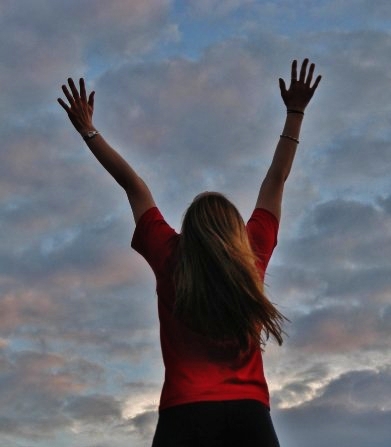
And binge on open sky that opens hearts which open mouths and together, we’ll speak from bodies standing tall, hands outstretched screaming “YESSSS!” until we’re breathless.

Copyright MO 2009

Copyright MO 2009

Ashes of Hope: My Love of Lent but Not of Murder on a Cross (PLUS 40 Days of Sustainability coming soon)

Even the winter won’t last forever. We’ll see the morning, we’ll feel the sun.
We’ll wake up in April, ready and able, Sowing the seeds in the soil.
Even the darkness cannot disarm us. We’ll see the morning, we’ll feel the sun.
-Audrey Assad

Easter is what many would argue to be the quintessential turning point of the Christian faith. The crux. The climax of the story. The thing that you must be able to articulate into carefully formed sentences depicting your belief, as though words and theology solely define your spirituality and very existence. Perhaps from all of this lies the basis for the trite messages that I, along with so many others, have heard about the Christian faith. “Jesus died for your sins.” “Jesus paid the debt.” “Jesus stood in your place and died for you so that you might have life.”

And if those words bear truth and meaning to you, I have not come to take them away, nor discredit them.

It’s just not the Jesus I’ve come to know, face-to-face in my human spiritual struggle. 

The Jesus I’ve come to know didn’t die at the hands of a blood-thirsty, vampire-like God who needs to see someone murdered in order to forgive people. The Jesus I’ve come to know, and the God to whom he points, is a rebel. A revolutionary who challenged the privileged and elevated the marginalized. Who spoke out of turn, unafraid to make people think harder about themselves and the world around them. Who taught us to slow down long enough from our exhausted minds to “look at the birds and flowers,” and to be a visionary in whatever issue your culture is facing.
Direct from the mouth of this revolutionary contains the most gripping parts of the Eastertide story, in my experience. The pieces that I rarely heard pastors and Bible study leaders quote. The part where Jesus, our supposed role model, screams up at God, “My God, My God, Why have you screwed me like this?”  Because that’s life, that’s reality. That’s the affirmation I look for when I’m stuck in the mud and mire and all around me are hope-depleted apertures crying out for just a flick of mercy from a kind and loving God, begging for auspices that come from this Divine Light. And to hear Jesus utter these same words gives me confidence that I am in good company when I am in the thick of the squall and my once blithe heart feels incapable of coming back to me. When I’m a low that low, that’s when I know I’m only a few steps out from mercy. Because we, like Jesus, get to experience the surge of joy that is the resurrection, ashes of hope that sing of redemption.

I think these ashes of hope are what the soul longs for. Beyond a good love story, a good hope story. To know that all of our troubles will not be squandered, but used for fodder to keep these tales of beauty-from-pain alive. To give us the fortitude to know, anchored in our core, that it doesn’t matter what comes our way, for it won’t last forever. But the feelings of hope and the aftermath of beauty will hit us so viscerally that we tear up at the thought, “I didn’t know life could be this good.”

This is why I haven’t given up on Lent or Easter, despite some of my theological wrestlings and frustrations with the traditional teachings of this spiritual season. Lent draws out the heart’s ability to draw nigh to your Creator. A 40 day season containing strong, beautiful symbolism. Death from life. Life from death. The two are inseparable. Hope is reborn, recycled out of crushed pain and heartache. The timing of this season enhances the meaning all the more to me, as we begin Lent in the waning winter, in which it is still snowing as I write this. But we end Lent well into spring. During those 40 days, shoots on trees develop, buds blossom to form magnolia flowers- my absolute favorite tree on this planet that reminds me there is no cold that cannot be endured to eventually give way to life. The sun graces us for 2.5 minutes longer each day, until we’ve accumulated some 177.5 minutes of additional daylight come Easter evening, thanks, largely in part, to Daylight Savings Time. (Can you tell yet that spring is my favorite season and consumes many of my thoughts?)

IMG_1815

Copyright MO 2013

And so I don’t know where your heart is this season. Maybe it’s hiding in guilt and shame, underneath a veil of many coverings, because you feel it has gone so far awry from any sort of “straight and narrow.” Maybe your heart is parched, longing for a bit of this hope story. Or maybe your heart abounds in a joy so full, that it might cry droplets of gratitude onto baby seedlings that will soon lean their faces toward the sun for the first time. But one thing I do know, as we forge into spring, is that all around you, life begs your soul to awaken, and if it cannot awaken on its own, let its colours take you to places unknown until hope uncovers and your soul sees vibrant hues ablaze in beauty.

But there will come a time, you’ll see, with no more tears.
And love will not break your heart, but dismiss your fears.
Get over the hill and see what you find there
With grace in your heart and flowers in your hair.
-Mumford and Sons


Coming tomorrow: My 40 Day Sustainability Plan- Come observe Lent through environmental social justice

Why We Must Support the Anti- Gay Bill, And So Much More.

Dear Arizona legislators,

Photo Credit: Sarah Bessey, Pinterest

Photo Credit: Sarah Bessey, Pinterest

I am writing to disagree with you about the recent proposal for anti-gay legislation– not because I don’t agree with you (it’s about damn time someone made sure that we only have to talk to people of heterosexual orientations), but because you haven’t taken the measure far enough in order to preserve our precious religious liberties.
We need to pass legislation to ensure that our business owners do not have to serve alcoholics. After all, why should we serve them, when the Bible clearly states that we “shouldn’t get drunk on wine, but instead, be filled with the Spirit?”
Similarly, we must also not be forced to serve overweight people. The Bible offers several verses against gluttony and we must take a stand against this perverse health condition.
We must also pass legislation to give business owners the religious freedom to not serve immigrants. God invented nation-states in Genesis 11, and we must not to violate that. Remember, the saying is “God Bless America,” not “God Bless Mexico.” Along with that, we should not be forced to serve people of different races— After all, God put the races on different continents for a reason.
Furthermore, we must not force business owners to serve women. Next thing you know, women will think they can be autonomous just like men. No. Women must stay at the home. If we let them patron restaurants without the presence of their husbands, they surely must be slacking on their homefront duties.
We also must not be forced to serve those on welfare. The Bible says that “God helps those who help themselves.” Um, hold on a minute while I find that verse. I can’t seem to find it, but it doesn’t mean it’s not there!
Moreover, we cannot be forced to serve those who have been divorced. We all know the Bible doesn’t support divorce, and we cannot be forced to interact with divorcees who might think that our interactions condone their marital departures.
It goes without saying that we cannot be forced to serve democrats, either, of course.

So there you have it. I believe the only people that are left are white, straight, males born in the Good Ol’ US of A. I hope that we can get enough patrons to support our businesses, but we must trust God on that one, brothers.

Sincerely,

Your white, straight, Republican, married-to-a-woman male Christian brother in Christ who thinks, looks, behaves, and believes just like you.

In case you haven’t picked up on this, this piece is purely satirical. I hope it can bring a laugh, but more importantly, draw attention for reflection upon privlege, equality, and respect for diversity. Please consider signing petitions or using your sphere of influence as a platform for justice, mercy, and love.

Photo Credit: http://bit.ly/1lm7idH

Photo Credit: http://bit.ly/1lm7idH

This Beautiful Moment Brought To You By Sir Mix A Lot (Or, What I Learned From Dancing On A Street Corner With a Homeless Woman)

Nietzsche

When I first saw her walking down the street, I confess I wanted to ignore her. She was wailing, flailing her hands, and muttering jumbled words I couldn’t make out. On a cloudless 65 degree day, she was walking down the street in a long wool coat, baggy pants, and worn sneakers. The wailing grew louder, and I put on my helmet, fiddling with my bike lock, ready to leave the cafe I just got done dining in. My friends had all left, and my bike lock was stuck. Annoyed at the lock, then annoyed at myself for thinking my dad’s high school U-lock would still work in 2014, I finally got the lock undone and pulled my bike away from the street sign. The woman was walking down the street toward me, and I was coming toward her direction to go down the road that would take me home. I planned on smiling at her and looking her in the eye to say, “Hello,” expecting I might get asked for money. It’s happened plenty of times before, so my thought was not unfounded. But instead something else happened.

Our eyes stopped glancing toward each other, because our ears heard something. We both turned our eyes toward music we noticed coming from the cafe’s outdoor speakers.

Jump On It, Sir Mix A Lot’s 1996 hit, was coming from the speakers for all passers-by to hear. She began to laugh. I began to laugh. She started dancing, moving her hips then pausing them at the precise time when the “dun-na-na-na-nah-nah-nahs” came on, laughing with her whole mouth. I couldn’t help myself. I slid right next to her just in time for the part where you turn around, swinging your arm over your head as though you’re waving around a lasso. Her infectious joy caught onto me, and the two of us—she in her long winter coat, and me wearing a neon shirt and bike helmet— danced like two fools intoxicated by the music and the warm sunshine that sang of spring’s soon-to-be debut.

We kept dancing, and I was grateful they played the extended remix version instead of the regular, as to get every minute in with my new dancing partner. Alas the song drew to a close, and we finished facing the sun, arms extended, our smiles and laughs communicating to one another, as if to say, “Gee, that was fun!”

I asked her for her name. “Terryn,” she replied. “I’m Melissa,” I replied back. She began to walk the other way, and started laughing at a car driving in reverse. I guess she expected it to go forward in drive, and the sight of it going the other direction was enough to set her off laughing. As I turned the corner to head home, she went back to talking to herself. But I was so grateful we got to dance together, if only for those few moments, in lucid clarity.

A colleague I work with was recently telling me about a training she went to in which attendees were required to go out in the community wearing headphones that played a recording of voices talking in various tones to mimic what people with schizophrenia go through. Instructed not to take the headphones off and not to adjust the volume, she and her friends in the training had to complete tasks around the community— find the nearest bathroom, ask someone on the street for directions, etc. “It was the hardest thing I’ve ever done,” she shared. “For the life of me, I couldn’t concentrate, and I felt crazy inside not being able to shut off the noises we were hearing. It gave me compassion. We really have no idea what it’s like,” she reflected.

I thought back to my colleague’s comment as this woman was walking down the street, back to talking to herself, and tried to put myself in her shoes. While I don’t know for sure that she had schizophrenia, I thought about what it would be like if it happened to me. How powerless or misunderstood I might feel. Maybe, I’d just want to love everybody I’d meet so fervently, but for the life of me, my words, thoughts, and behaviors wouldn’t be able to follow through. The woman I danced with, though, had a beautiful lucid moment, as though she was trying to love like that.

It reminds me of my favorite poem by Mark Nepo called “Life in the Tank.” In it, he describes an experience in which a child filled a bathtub for his fish to swim in while he cleaned their fish tank. Though the fish had the entire tub in which to play, they stayed huddled together in a corner, as though they never left the tank, when all surrounding them in every direction was fresh water to explore. Muses Nepo,

“Life in the tank made me think of how we are raised at home and in school. It made me think of being told that certain jobs were unacceptable and that certain jobs were out of reach, of being schooled to live a certain way, of being trained to think that only practical things are possible, of being warned over and over that life outside the tank of our values is risky and dangerous.”

I wonder if the same can be said for our interactions with people. How many of us were told what people were “safe,” what people to avoid, who to talk to, and who to not even make eye contact with? Many of us were cautiously told “don’t talk to strangers” by someone who loved us with the best of intentions.

But is that the best we can do out there, in the real world? What soul-to-soul conversations have we missed because we were following the “don’t-talk-to-strangers” framework? What divine spark have we missed out on; what song did we miss dancing to, what high five did we not exchange because of the “life in the tank” mentality?

Caution has its merit, and so does instinct and prudence. Our hearts can’t be given away to everyone and anyone. But I wonder if our hearts are more malleable than we think. I wonder if we are meant to escape from the constricting layers that tell us to “just keep walking,” as if to keep every part of ourselves intact, not risking the opportunity for community and connectedness?

All of these things I ponder as I bike home after my interaction with my dancing stranger friend. The news in most cities- Baltimore, no exception- often shout of violence and try to covertly scare citizens into never coming outside, or to go outside- if you must- but don’t you dare come out of your shell of self-protection. My heart breaks over stories of innocent people victimized by violence for no apparent reason, other than the cliche “they were in the wrong place at the wrong time.” But maybe it’s time we start daring ourselves just a little bit more to believe in the possibility that we might be “at a great place at a great time.” That now is the perfect time to start dancing to the music- the music that may or may not even be audible. To be a little foolish. To invite someone new into conversation with dignity and sincerity. Yes. I’ll bike through these streets with both circumspect acuity and a posture of openness- open and ready to sing, dance, or high-five when laughter is our gain and excessive guardedness our loss. 

Copyright: O'Doherty Photography

One of my favorite events that brings community members together is Baltimore Bike Party, as pictured above. 
Photo credit: O’Doherty Photography